In this guide
- The quick answer for most buyers
- What buying vs. building actually costs
- How long each path takes to first revenue
- The risks unique to each route
- How financing differs (SBA vs. construction loans)
- When building is the smarter move
- A simple way to decide
Key takeaways
- Buying delivers immediate cash flow, an existing license, and trained staff; building delivers control but generates no revenue for 18–36 months.
- Ground-up assisted living construction runs roughly $200–$250+ per square foot (RSMeans 2019 U.S. national average of $200–$222; higher after 2024–2026 cost increases).
- Acquisitions up to $5 million often qualify for SBA 7(a) financing; new builds usually require construction loans with larger equity and personal guarantees.
- Most first-time owners are better served buying; building suits experienced operators with time, capital, and a specific market gap.
Is it better to buy or build an assisted living facility?
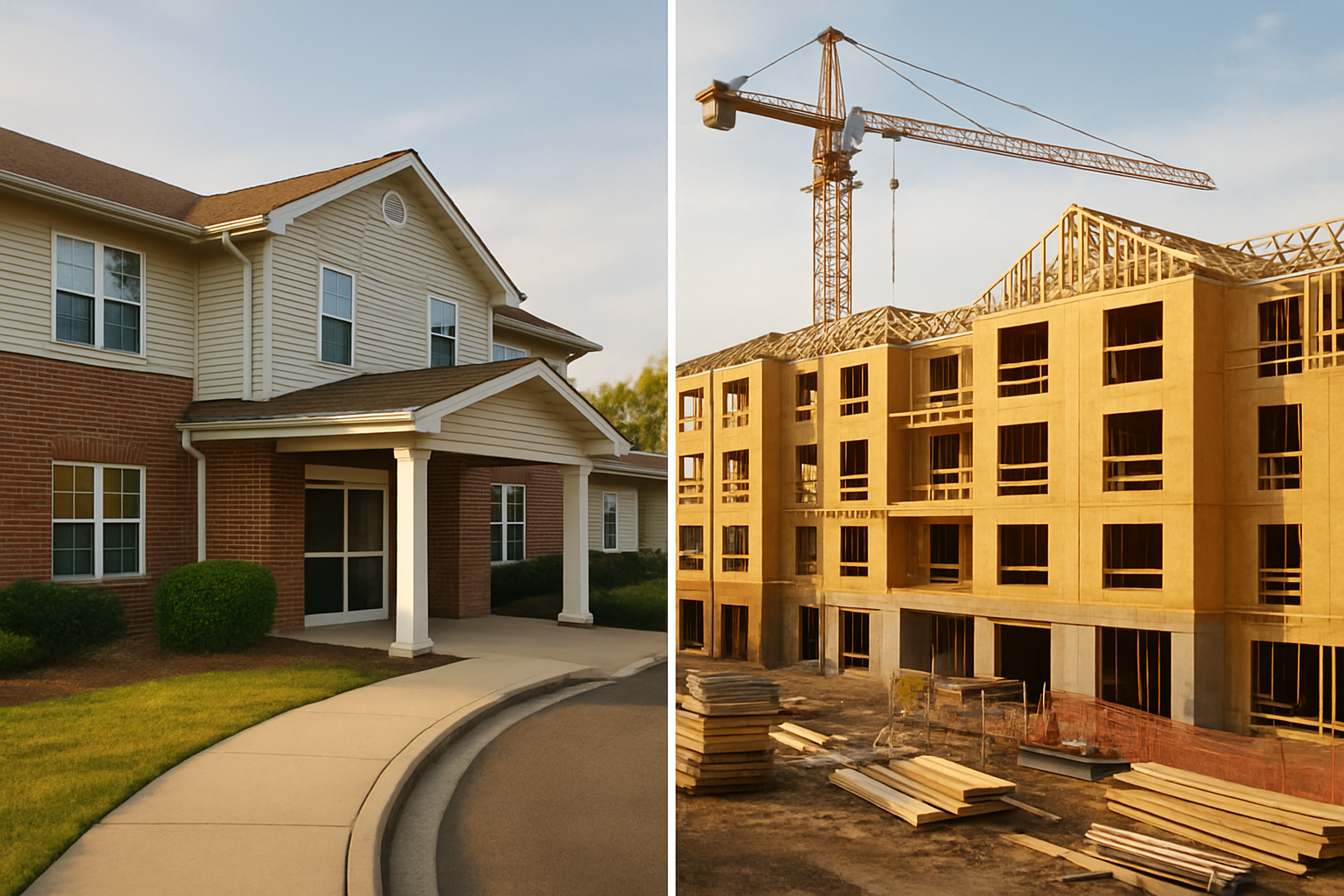
For the majority of buyers, buying an existing facility is the better move — it hands you a running business instead of a construction project. When you buy, you step into a facility that already has residents paying rent, a state license, and a trained care team, so cash flow starts on day one. When you build, you spend 18–36 months and a large amount of capital before you can enroll your first resident, and you carry that risk with no income coming in.
Building wins in narrower cases: when no suitable facility is for sale in your target market, when you need a specific care model or physical design, or when you are an experienced operator who can manage entitlement, construction, and lease-up risk. The right answer depends on your timeline, your capital, and how much execution risk you can absorb. If you are still deciding whether ownership is right for you at all, start with our guide on how to buy an assisted living facility.
How much does it cost to buy vs. build?
The headline difference is what you are paying for. Buying prices the business on its income; building prices the real estate plus everything it takes to get licensed and full.
| Factor | Buy an existing facility | Build a new facility |
|---|---|---|
| Basis of price | Net operating income ÷ cap rate | Land + hard + soft costs |
| Typical cost driver | Purchase price of a cash-flowing business | ~$200–$250+ per sq ft to construct |
| Upfront capital | Down payment (often 10–20% with SBA) | Larger equity + construction loan |
| Revenue at close | Immediate — residents already in place | None until licensed and leased up |
| Renovation/CapEx | Possible deferred maintenance | New building, minimal early CapEx |
Because a purchase is priced on income, the way to protect yourself is to value the business on its numbers — see how assisted living facilities are valued — and to run a thorough due diligence checklist before closing. A build, by contrast, is priced on construction: RSMeans pegged assisted senior living at roughly $200–$222 per square foot (2019 U.S. national average for a 100,000 sq ft facility), and Senior Housing News reported assisted living construction costs rose again in 2026, so budget above that base today.
How long does each path take to first revenue?
Buying can produce income immediately; building usually takes 18–36 months. With an acquisition, the clock is set by financing and the license transfer (a change-of-ownership, or CHOW, approval), commonly 60–120 days from offer to close — and the facility keeps earning the whole time.
A ground-up build stacks up sequentially: site selection and entitlement, permitting and zoning, construction, state licensing, and then lease-up to stabilized occupancy. Any one of those can slip, and none of them generate revenue. For most buyers, the months of carrying costs with zero income are the single biggest reason to buy rather than build.
What are the risks of buying vs. building?
The risks are different in kind, not just degree. Buying carries "hidden problem" risk; building carries execution risk.
When you buy, the dangers are deferred maintenance, an inherited reputation, staff turnover, and previous-owner liabilities — all of which good due diligence can surface before you commit. When you build, the dangers are permitting delays, construction cost overruns, and a slow lease-up that leaves you paying debt service on an empty building. Buying lets you inspect a known quantity; building asks you to underwrite a series of things that have not happened yet.
How do you finance a buy vs. a build?
Financing is often the deciding factor. Acquisitions up to $5 million frequently qualify for an SBA 7(a) loan, which allows a relatively low down payment because the lender is underwriting an existing, cash-flowing business. That makes buying accessible to first-time owners who could never fund a build.
New construction typically requires a construction loan (or SBA 504 for owner-occupied real estate) with a larger equity contribution, personal guarantees, and interest carried during construction before any rent arrives. The lending math consistently favors buying for owners who want to preserve capital and start earning sooner.

When does building make more sense?
Building is the right call when the market leaves you no good option to buy, or when you are set on a specific model. This is especially true in residential assisted living (RAL) — small care homes, often converted single-family houses — where operators frequently build or convert to hit a precise design and location. If that is your path, the "how to build, license, and operate" side lives with our sister brand: learn the operator model at The RAL Room. BSAL's job is the transaction — helping you buy or sell an existing facility — so when your intent shifts to building and operating, we hand you up to the right resource.
Build when: nothing suitable is for sale in your market, you need a care model or layout no existing home offers, you have the capital and time to carry 18–36 months with no revenue, and you (or your team) have operated before.
How to decide: buy or build
Run the decision through four questions: How fast do you need income? How much capital and execution risk can you absorb? Is there a facility worth buying in your market right now? And how specific are your design and care-model requirements? If speed, existing cash flow, and financing access matter most, buy. If control and a specific vision matter most and you can wait, build.
When you are ready to look at facilities that are actually for sale — and want a specialist who works these deals — connect with a Buy Sell Assisted Living expert. We keep you in the loop from valuation through closing.
Informational only — not financial, legal, tax, or investment advice. Verify current costs, loan terms, and licensing requirements with qualified professionals before acting.